Verification
Trust it because you can check it.
Two kinds of proof, and you get both: independent engineers have verified PaveXpress against the AASHTO guides — and every calculation is shown, so nothing asks for your faith.
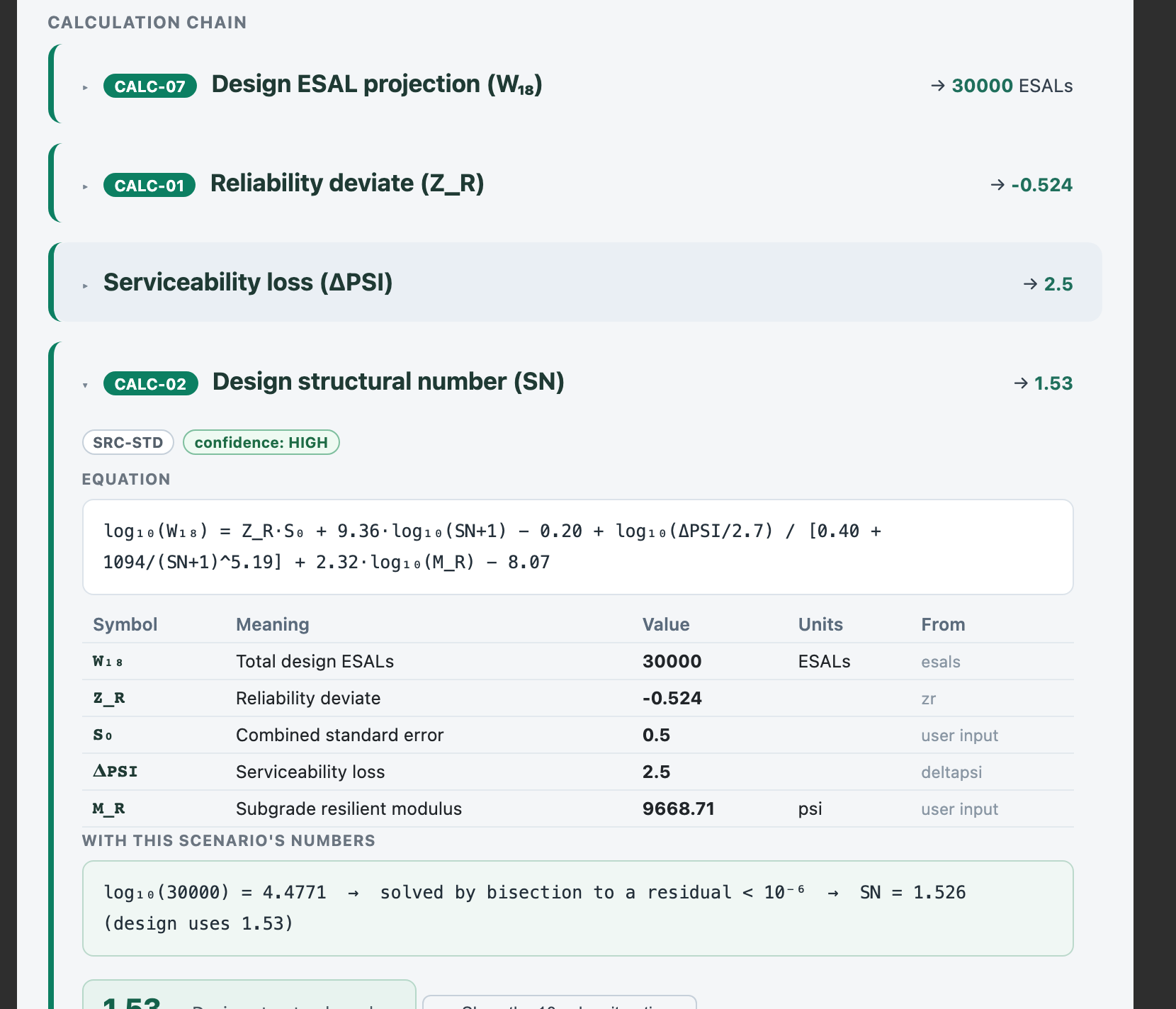
log10(W18) = ZR·S0 + 9.36·log10(SN+1) − 0.20 + log10(ΔPSI / 2.7)0.40 + 1094 / (SN+1)5.19 + 2.32·log10(MR) − 8.07
log10(W) = 5.85 + 7.35·log10(D+1) − 4.62·log10(L1+L2) + 3.28·log10(L2) + G / Y
+ (5.065 − 0.03295·pt2.4)·[ log10(S′c / σ′t) − log10(690 / σt) ]
MR = 2,555 · CBR0.64 MR = 1,000 + 555 · R
r = √load / (π · pressure) — derived, never entered
PW = cost · (1 + i)−year — the year is the exponent, not a label
The published equations, implemented as written — solved live, with every term inspectable on every result. Not a simplification of AASHTO; an implementation of it.
The methodology
AASHTO ’93 · ’98 supplement
New flexible and rigid design, overlays, and porous pavement follow the AASHTO Guide for Design of Pavement Structures (1993) and the 1998 supplement for rigid pavements — the coefficients, equations, and reference data as published.
Asphalt Institute MS-23
Heavy Vehicles design follows the Asphalt Institute’s Thickness Design — Asphalt Pavements for Heavy Wheel Loads, validated against the publication’s own worked examples.
Mechanistic-empirical
PerRoad perpetual-pavement analysis uses layered elastic theory with strain-threshold checks, following the published PerRoad methodology.
What "shows its work" actually looks like
Every result carries a calculation report: the governing equation, every symbol's value and where it came from, findings for review, and a self-check that replays the solver against the stored result.
The independent evidence
Every report is public. Read them, then re-derive any design yourself — the full calculation trail is on every result. A formal certification program with additional agencies and institutions is in development.
Run the numbers. Check the numbers. Ship the design.
Free — always. Every calculation shown.