Modules
From first section to life-cycle cost.
Seven working engineering tools. Pick one — everything about it, on one screen.
Pavement Design
AASHTO ’93 · ’98 supplement
Reach for it when: You need a thickness: how deep the asphalt or how thick the slab, given the traffic, the subgrade, and the reliability you're designing to.
You bring
- Traffic (AADT / annual / design ESALs)
- subgrade Mr or CBR/R-value
- reliability
- serviceability
You get
- solved SN
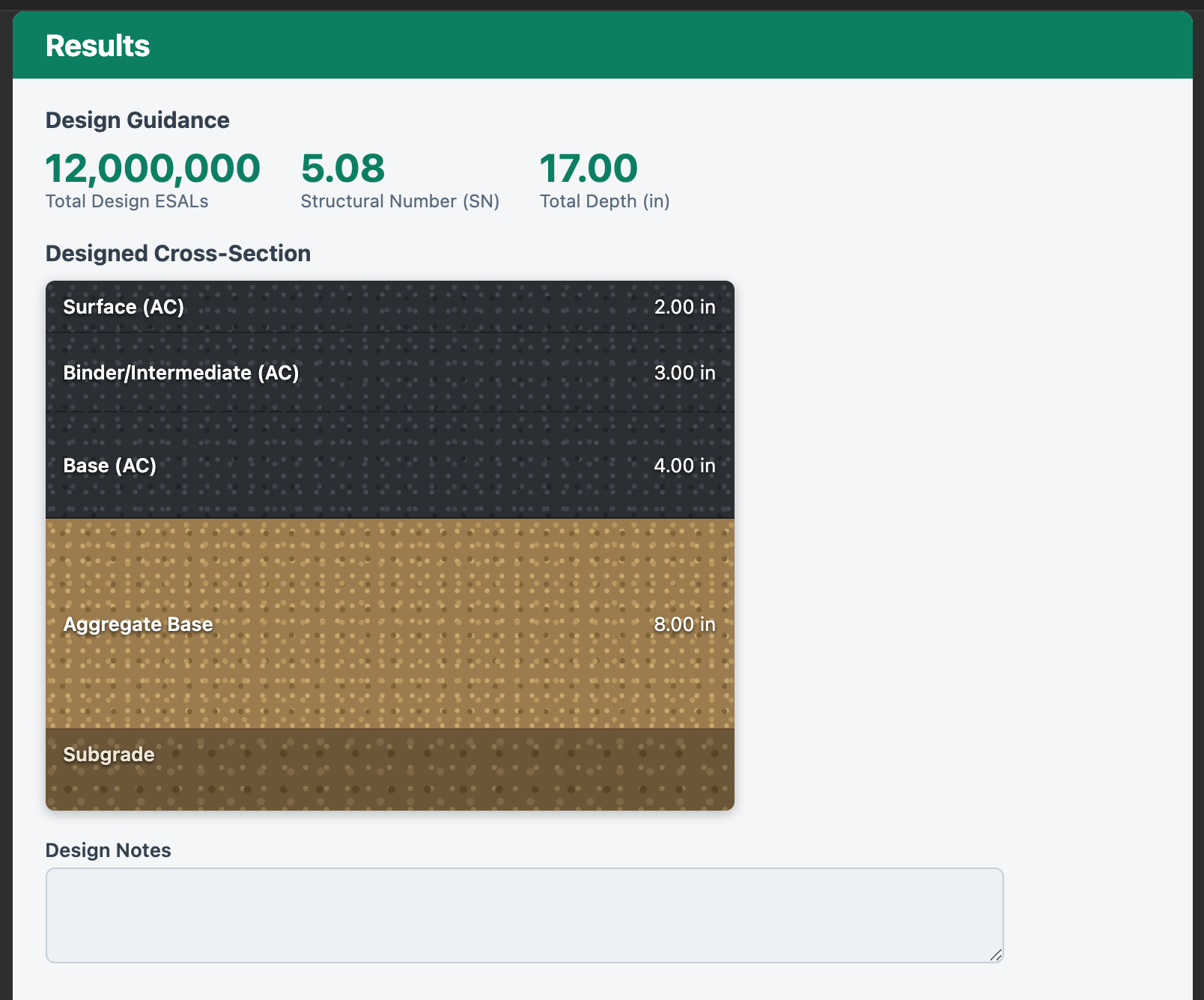
- layer stack
- slab thickness
- full derivation
What you get
A solved structural number and the layer thicknesses that satisfy it, rounded up to your construction increment; a cross-section drawing; design guidance including constructibility warnings; and a calculation report showing every equation with your numbers in it. A material cost estimate, a life-cycle comparison, and a mechanistic check sit alongside the result.
What you need to start
Pick a pavement application and type — the wizard's steps follow from that choice, so a porous design is never asked about joint spacing. Then design period and reliability, traffic as ESALs (entered directly, annually, or from AADT), subgrade support, and the layers you intend to build.
The engineering
Five pavement types, each on its published procedure: AASHTO '93 flexible for new asphalt, the '98 supplement for rigid slabs, a Burmister two-layer composite subgrade for porous, and overlay design from the structural-number deficiency — with the existing pavement evaluated by condition survey or NDT backcalculation. Light-duty parking lots deliberately skip structural design rather than computing a number that wouldn't mean anything.
Heavy Vehicles New
Asphalt Institute MS-23 · NAPA QIP-123
Reach for it when: The load is not highway traffic: a container yard, an intermodal terminal, a boat yard, a log-handling area. Loads that are very heavy, very slow, and sometimes stationary for long periods.
You bring
- Wheel load
- tire pressure
- load repetitions
- subgrade
You get
- full-depth asphalt thickness with the MS-23 basis shown
What you get
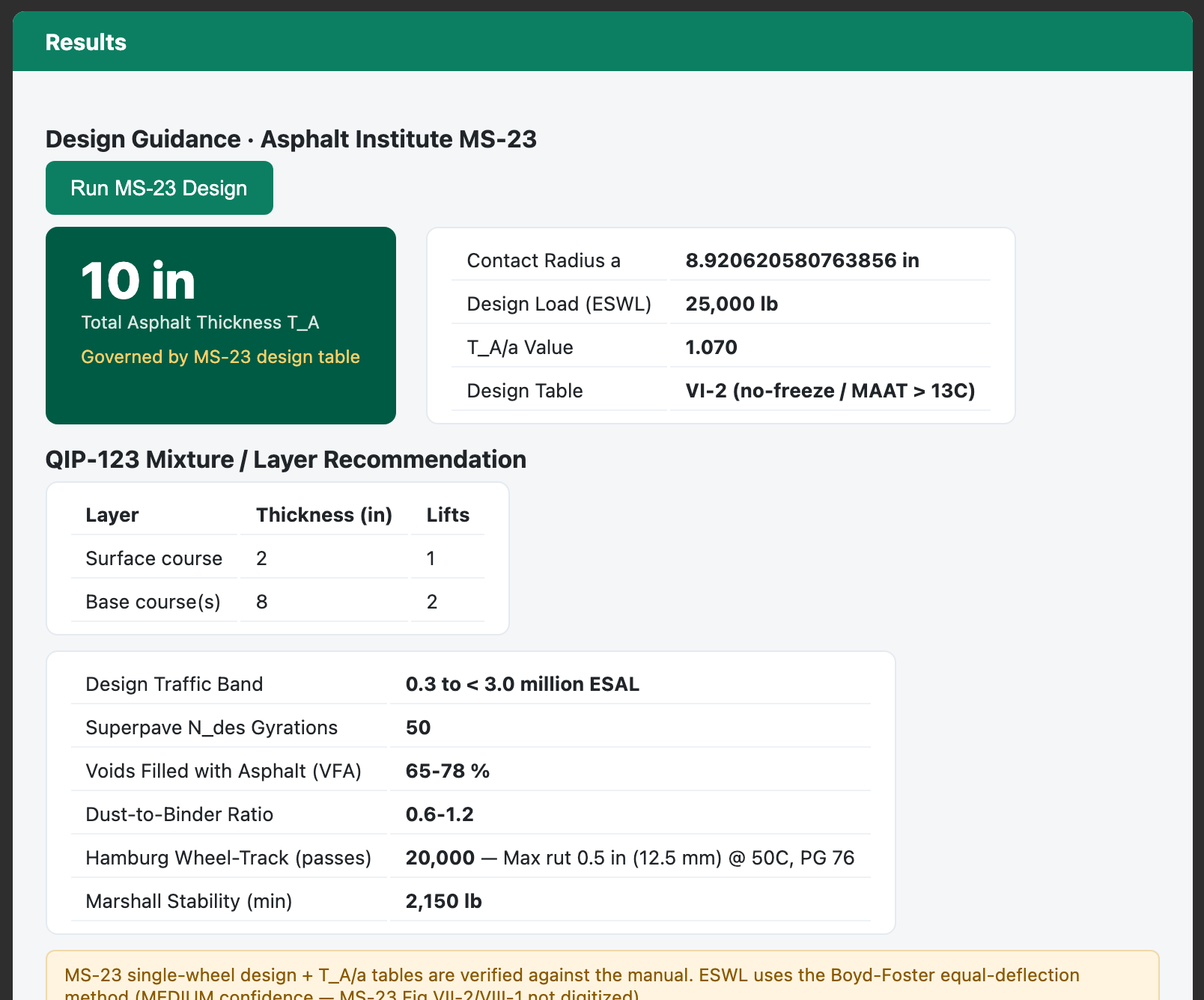
The equivalent single wheel load, the total asphalt thickness from the MS-23 design tables, the minimum-thickness check, and mixture and layer guidance drawn from NAPA QIP-123.
What you need to start
Wheel load and contact pressure, wheel spacing where the load rides on duals, container weight where relevant, load repetitions, subgrade resilient modulus, and the binder's high-temperature performance grade — or pick representative equipment from the vehicle interpreter.
The engineering
AASHTO's equation is calibrated on highway traffic converted to 18-kip axles; a loaded container handler is neither 18 kip nor moving at highway speed, so MS-23 designs for these loads directly. The equivalent single wheel load is read from MS-23's own charts, digitized and checked against the worked examples the manual prints, and the calculation report states its confidence on that step.
Life-Cycle Cost Analysis
FHWA-consistent LCCA
Reach for it when: Two sections both work structurally and you have to defend choosing one — a thicker initial build against a thinner one that will need resurfacing twice.
You bring
- Alternatives
- activity timelines
- unit costs
- discount rate
You get
- NPV / EUAC by alternative
- sensitivity ranges
What you get
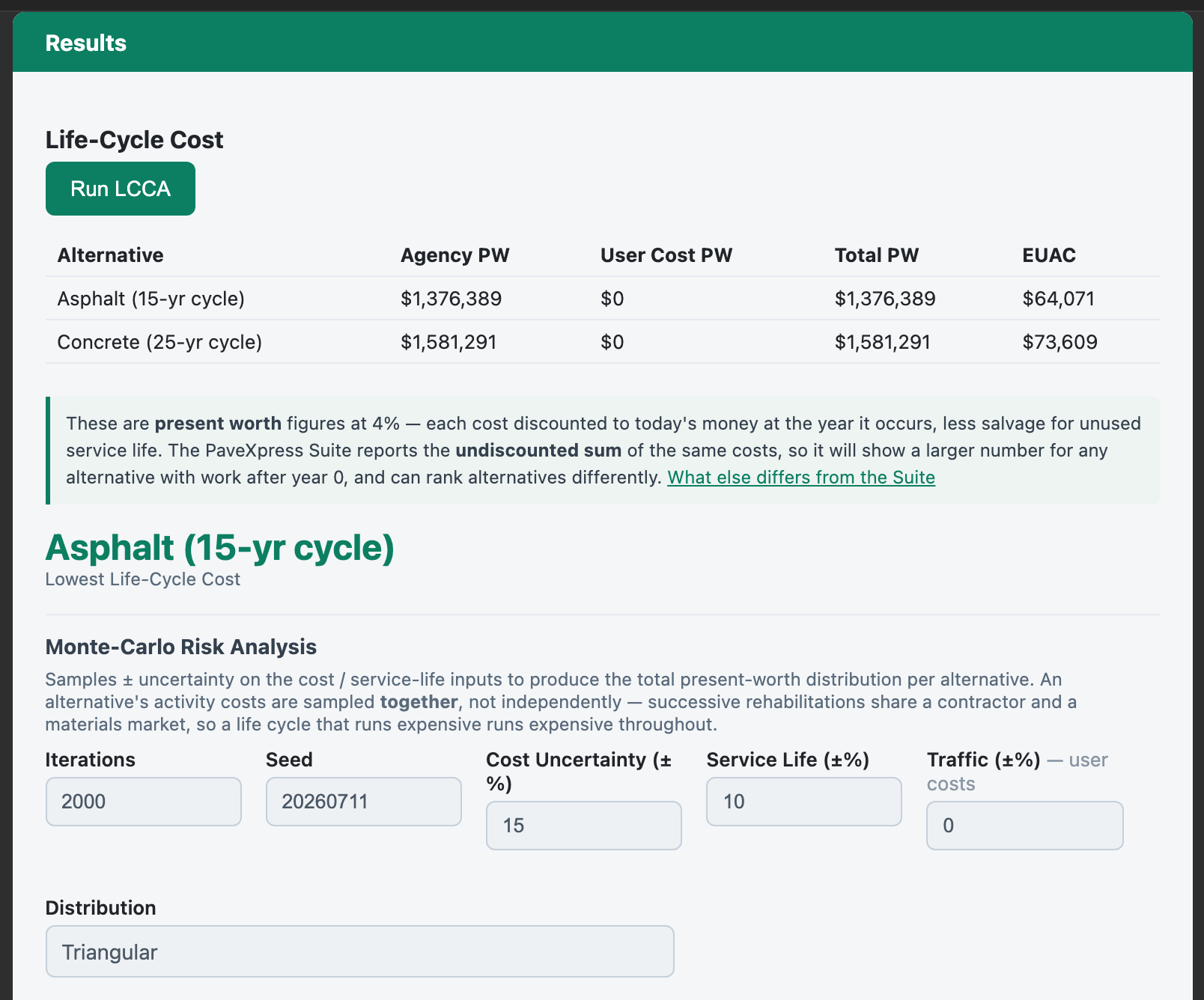
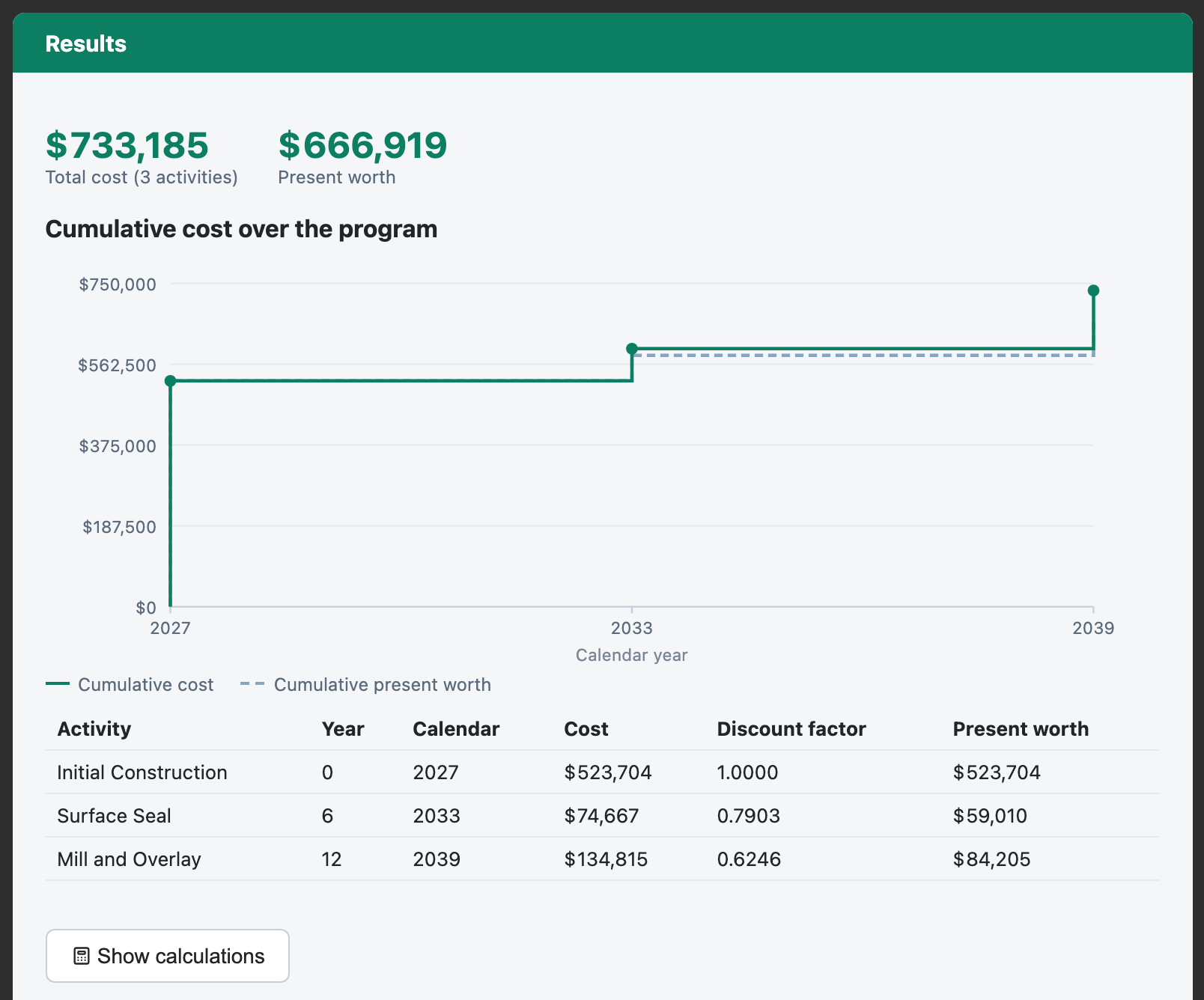
For each alternative: nominal cost, agency present worth, salvage prorated for life remaining, total present worth, and equivalent uniform annual cost — plus which alternative is lowest and a cash-flow timeline. With user costs on, delay and vehicle-operating components are reported separately from the agency figure.
What you need to start
An analysis period and a discount rate, then two or more alternatives — each an initial construction plus the rehabilitations that follow, with the year, cost, and service life of each. Optionally, road-user costs: work-zone traffic, lane closures, and the value of time by vehicle class.
The engineering
The year of each activity is the exponent in the present-worth factor, not a label — the same work moved later is worth less today. Salvage credits the unused service life of the final activity: the work itself, not the structure beneath it. Work-zone user costs come from a queuing model where the closure window matters as much as capacity, and a queue past your threshold produces a warning, never a silent clamp.
PerRoad
Mechanistic-empirical
Reach for it when: You're designing perpetual pavement, and the question is not "does the design axle pass?" but "how much of the real traffic does any damage at all?"
You bring
- Layer moduli & thicknesses
- traffic spectrum
You get
- strain responses vs thresholds
- damage estimate
What you get
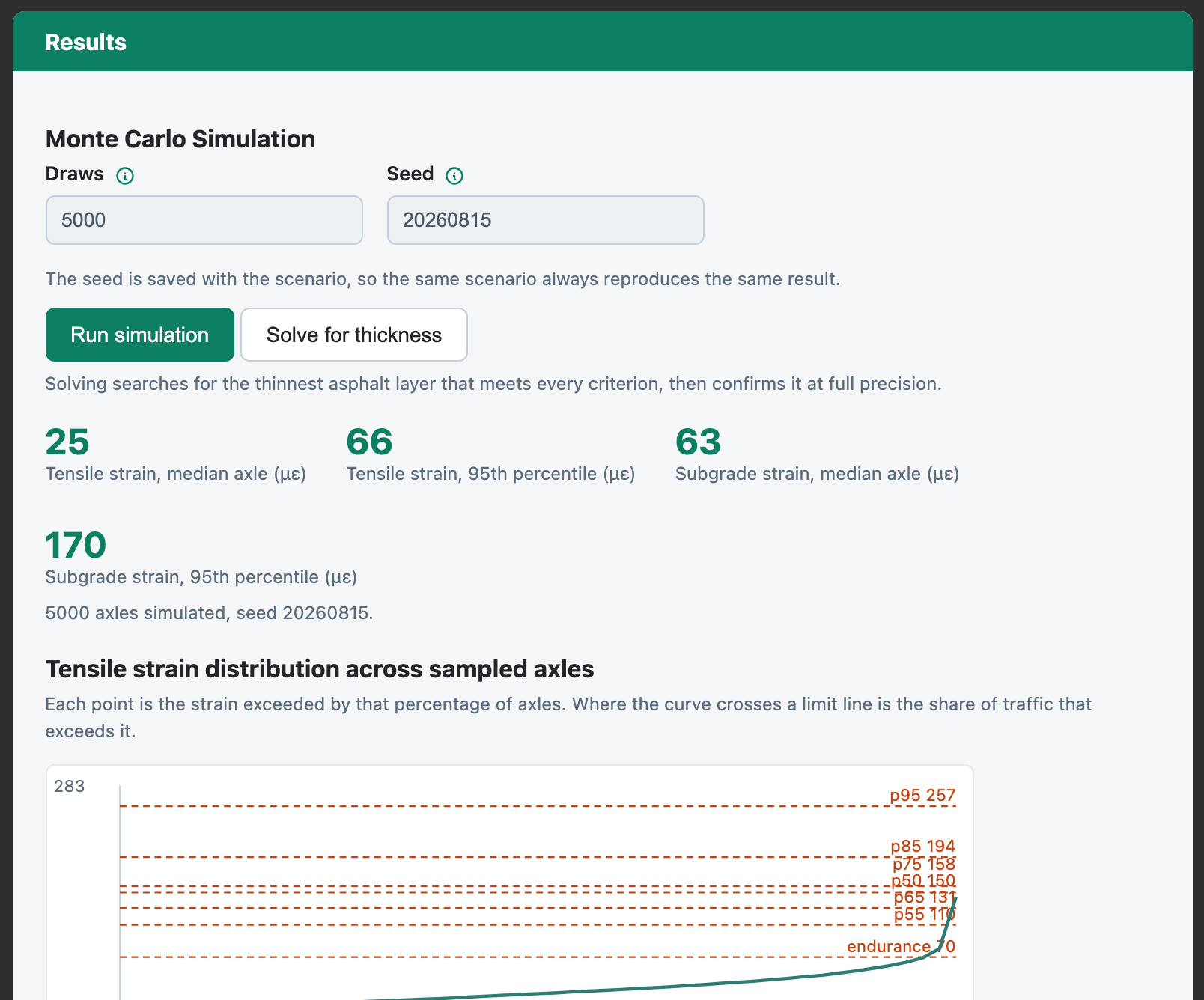
A distribution of pavement responses instead of a single number, checked against three criteria: fatigue strain at the bottom of the asphalt, rutting strain at the top of the subgrade, and the whole strain distribution against a published percentile ladder — with the count of draws exceeding each threshold.
What you need to start
A layer stack and subgrade, a season table — each season's length and temperature, since asphalt stiffness is strongly temperature-dependent — a roadway class, the number of simulation draws, and a random seed.
The engineering
Most axles do no fatigue damage at all — they fall below the endurance limit — so a perpetual design is governed by the tail of the distribution, which a single-axle check cannot see. Every simulated axle draws its season and temperature. The random seed is stored with the scenario, so any run can be reproduced exactly by a reviewer.
Structural Analysis
AASHTO structural capacity
Reach for it when: You want to know what a section actually does under a wheel, rather than what structural number it adds up to. The AASHTO procedure is empirical; this one is mechanistic.
You bring
- Existing layers
- condition
- traffic
You get
- effective SN
- remaining capacity
What you get
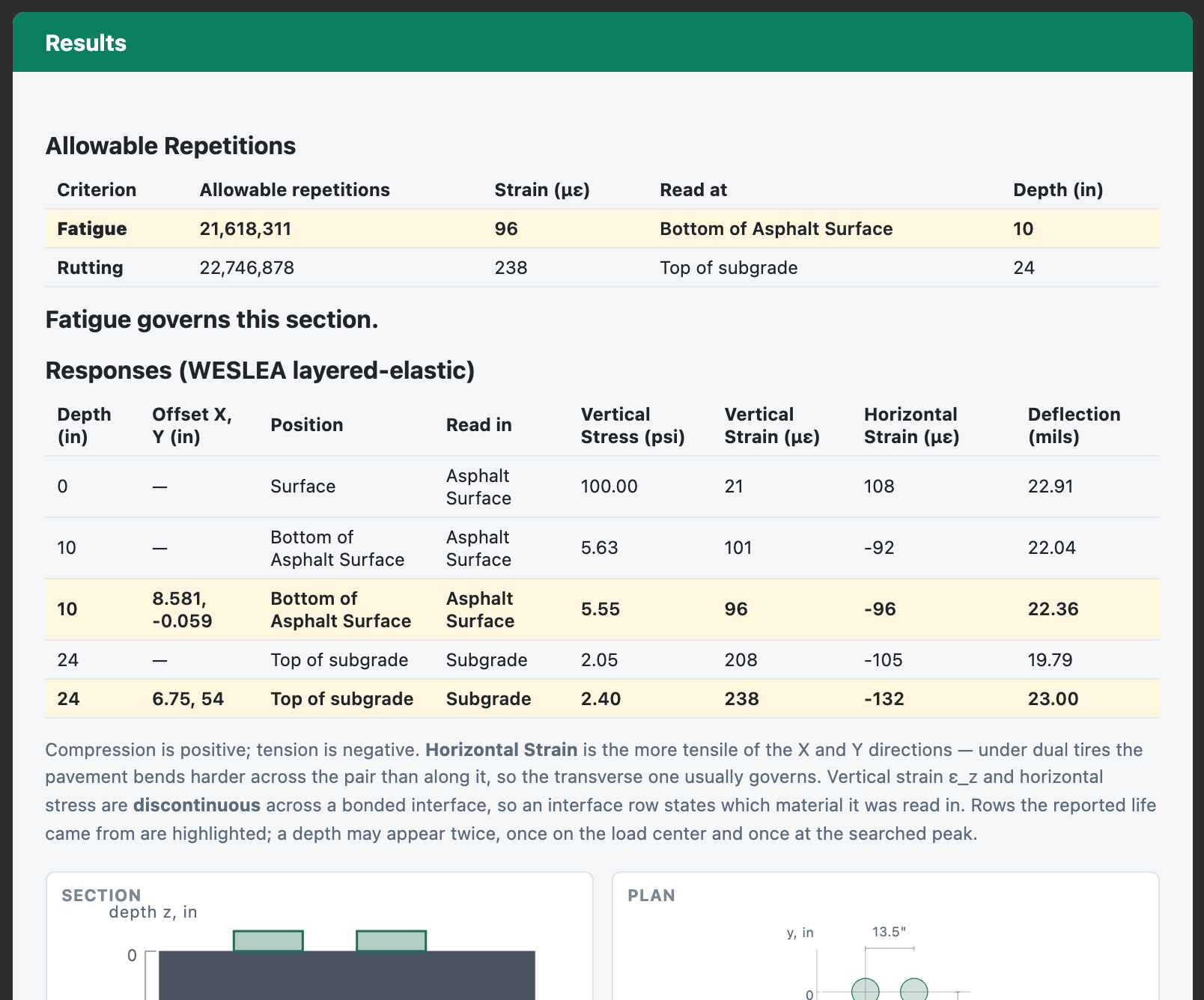
Strains at every layer interface — always computed, with the fatigue and rutting peaks searched across the loaded area — allowable repetitions through the transfer functions, and section and plan drawings of the load you described.
What you need to start
A layer stack — material, modulus, Poisson's ratio, thickness — over a subgrade; a loading pattern and the total load on the axle group; and the transfer functions that turn strain into allowable repetitions. A new scenario starts at the AASHTO standard axle: 18,000 lb, dual tires, 100 psi.
The engineering
You never have to say where to evaluate: every interface is computed by construction. The tire's contact radius is derived — r = √(load ÷ (π·pressure)) — never entered, so you cannot describe a tire that doesn't exist. Defaulting to the AASHTO standard axle means the mechanistic check speaks the same language as the structural-number method it sits beside.
Agency Cost
Quantity takeoff
Reach for it when: You need the cost of a section rather than a comparison between sections — a number to put in a program, or the initial cost to feed a life-cycle analysis.
You bring
- Section
- geometry
- unit costs
You get
- itemized construction estimate
What you get
Quantities computed from the geometry, each line item priced, activities totaled, and the estimate as a whole — paved area in square yards, the unit paving is priced in; volume items in cubic yards.
What you need to start
The project geometry — length, width, and shoulder width in feet — then one or more activities, each holding line items: a name, a thickness where the quantity is measured by volume, and a unit cost.
The engineering
The unit of every stored number is declared in one registry that both the interface and the calculation read — so a feet-versus-yards confusion, a factor of nine in area, is structurally impossible rather than merely tested for.
Mix Selection
Application-based guidance
Reach for it when: The thicknesses are solved; now you need to say what goes in each lift — gradation, aggregate size, and whether the lift can actually be laid at the thickness the structure asked for.
You bring
- Traffic
- application
- climate
You get
- recommended mix families
What you get
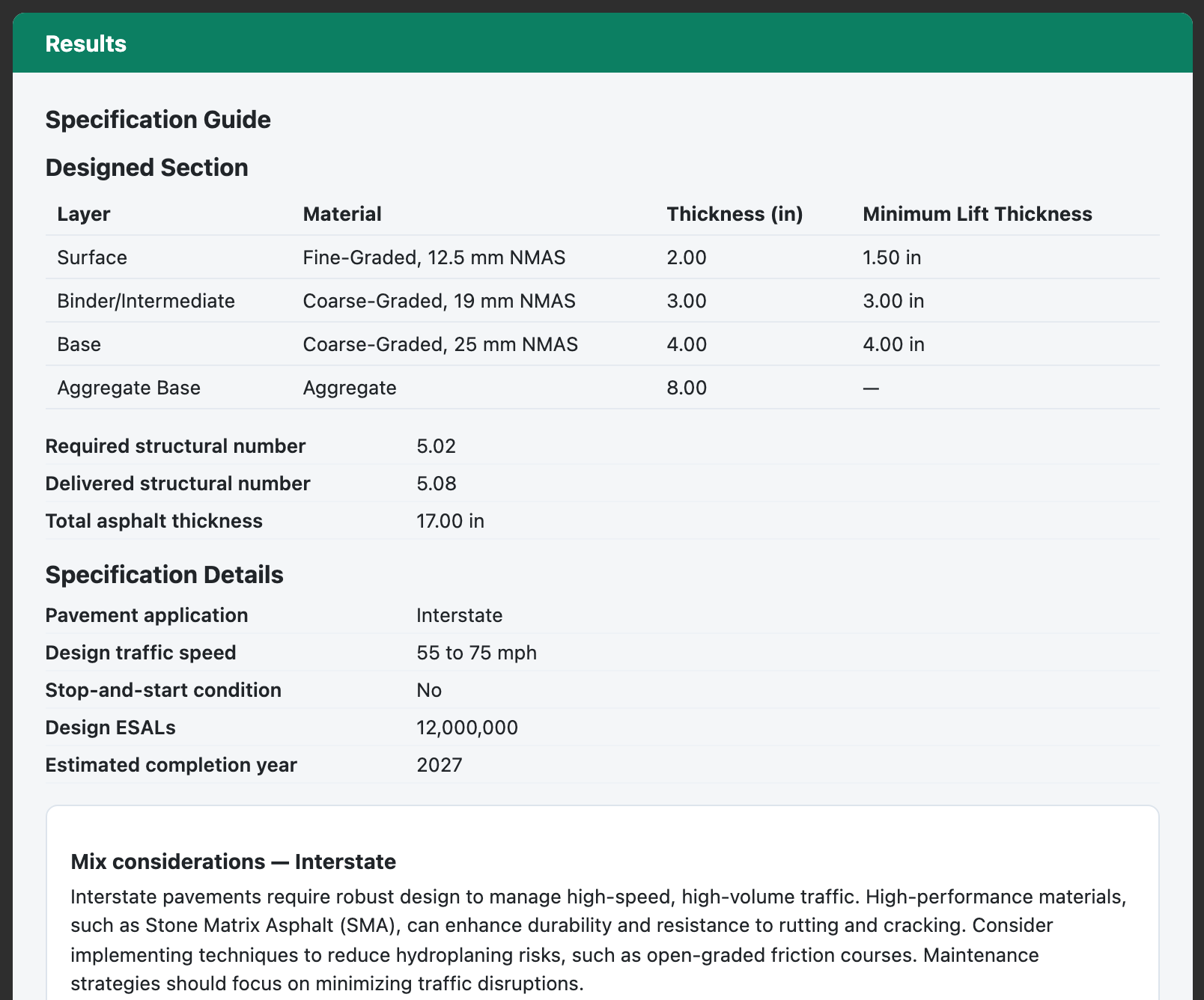
The flexible design re-solved with a mix on every lift, plus a printable Specification Guide: the section, the mixes, the design traffic speed, and the stop-and-start condition.
What you need to start
The same design parameters an asphalt design uses — or import a completed design, which copies them across rather than making you retype them — plus a mix on each surface lift: its gradation and nominal maximum aggregate size.
The engineering
A lift thinner than about three times its mix's nominal maximum aggregate size — four for a coarse gradation — cannot be compacted to density regardless of the structural number. PaveXpress warns and does not block: the engineer decides, not the tool. Design parameters are cataloged once across Design and Mix Selection, so an imported design can never silently drift.
Every module included in every free account.
Free — always. No tiers, no locked modules.